Paydirt Residency
The final gesture of One Hand Washes the Other responded to the allocation of Lassonde’s donation to Mount Allison to fund The Pierre Lassonde artist-in-residence within the art school. My project coordinated a counter-residency hosted by Struts dedicated to supporting the presence and work of artists articulating a critique of Canadian mining and its consequences. Following a public open call, the artist duo Romi Fischer-Schmidt and Stevens Barrios-Loch were selected for this opportunity. I used a portion of my grant towards an artist’s fee for these artists that matched the fee offered to the Lassonde artist-in-residence.
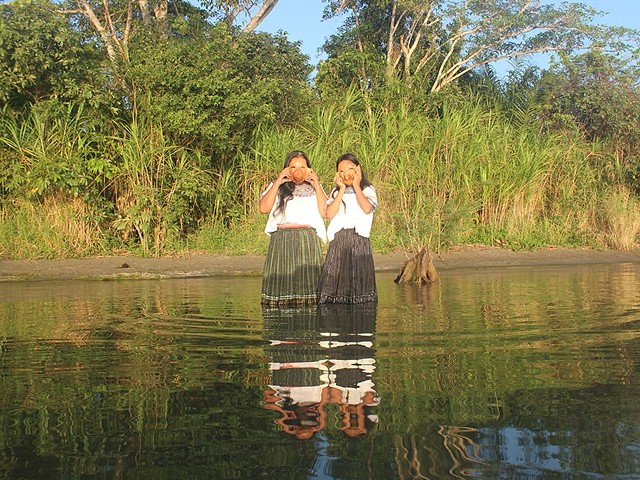
The artists’ work engages locally with El Estor, a community on Maya Q’eqchi’ territory (Guatemala), the epicenter of a sixty-year struggle against a mining company locally known as la empresa. Since 1960, Canadian mining corporations have funded deadly destruction through many means: INCO lobbied the military government to alter the Guatemalan constitution to allow for open pit mining. The same mining company, in 1978, was involved in the first of the 626 massacres of Maya people that took place during Guatemala’s civil war (1960-1996). In 2004, Sky Resources purchased la empresa, and collaborated with police, military and security to evict Q’eqchi’ people from their lands. All the while, the mountainside jungle, Q’eqchi’ village sites, and water sources are blown up and sent away to be sold, leaving a barren red scar. There is no succinct way of describing how profoundly disruptive it is to the Indigenous eco-cultural fabric of El Estor. Today, with the looming threat of the Río Nickel mining project by Montreal-based company ‘Central America Nickel Inc.,’ the community is mounting a blockade.
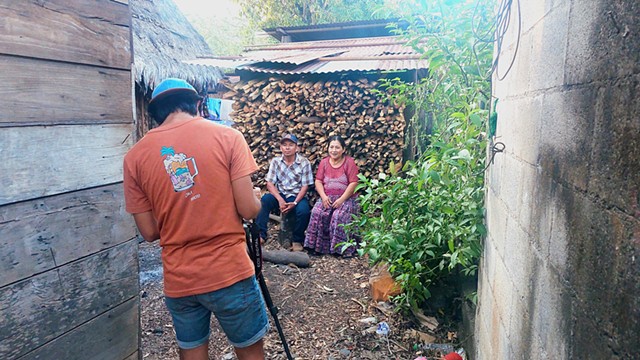
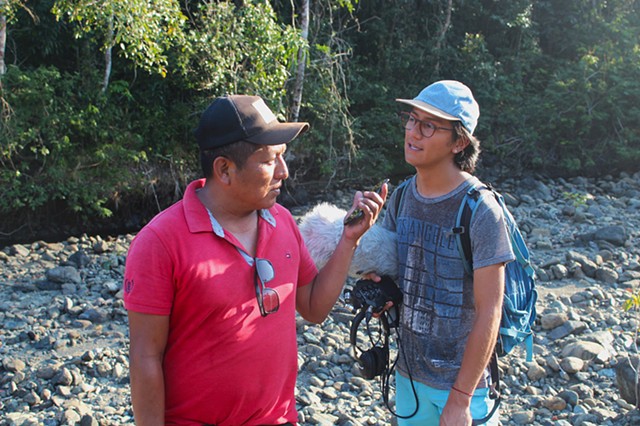
Having established relationships with the community of El Estor over the past six years, media artists and musicians, Styvens Barrios Loch and Romi Fischer-Schmidt, aim to communicate the struggle of Maya Q’eqchi’ people in one of many mining industry sacrifice zones. The artists’ practice fuses community-based participatory research with music and audiovisual creation.
Organizing this counter-residency as an artistic form mirrors how philanthropy constitutes a practice of cultural articulation: money and its expenditure is used to augment a particular message. Using funding as an artistic material is a form of philanthropy-as-artwork that reflects on the complicit terms offered to the Pierre Lassonde artist in residence.